When a dog bites or nips, it can feel shocking. It can feel sudden. It can feel out of nowhere.
But in the vast majority of cases, a bite is not the first thing the dog tried.
A bite is usually a last resort a dog reaching the end of their coping skills, after stress, fear, pain, pressure, or confusion has built up and their earlier communication hasnt worked.
This blog is here to explain why dogs bite or nip, what often leads up to it, and what your dog may have been saying in the moments (or weeks) before.
First: biting is communication not badness
Dogs don’t bite because they’re evil, spiteful, or trying to be in charge.
Dogs bite because, in that moment, they believe they have to.
It can be:
- Fear (I need you away from me)
- Pain (That hurts, stop)
- Protection (I’m scared and I’m defending myself)
- Overwhelm (I cannot cope with this)
- Frustration (I’m trapped and I cannot get away)
- Resource guarding (I’m terrified you’ll take this)
A bite is often the dog saying, in the only way they know how:
I have run out of safer options.
The bite ladder: dogs usually climb before they bite.
Most dogs don’t jump straight to biting. They climb a ladder of stress signals.
If the early signals are missed, ignored, or punished, the dog learns that subtle communication does not work and they may skip steps next time.
That’s why bites can start to look sudden: the dog has learned not to bother with the quiet warnings.
What your dog may have been saying before the nip or bite
1) I’m uncomfortable (early micro-signals)
These are the tiny signs people often miss:
- turning head away, avoiding eye contact
- lip lick / tongue flick
- yawning that doesn’t match tiredness
- sudden stillness (freezing)
- moving weight back, leaning away
- ears pinned or constantly changing position
- whale eye (showing the whites of the eyes)
- taking treats harder, or refusing food
- sniffing the ground suddenly (displacement)
These are not random behaviours. They’re the dog trying to cope and communicate.
2) Please stop (clearer warnings)
If the situation continues, many dogs escalate to clearer signals:
- moving away
- hiding behind furniture or behind the owner
- stiffening when touched
- closing the mouth tightly, tense facial muscles
- low growl
- showing teeth
- snapping the air (a warning snap)
A growl is not a problem. A growl is a gift.
It is the dog saying: I’m not okay. I need space.
If we punish the growl, we do not remove the fear we remove the warning.
3) I’m trapped (the tipping point)
One of the biggest drivers of biting is feeling trapped.
In human terms: if you were panicking and someone blocked your exit and kept coming, your body would escalate.
Dogs often feel trapped when:
- they’re on a tight lead
- they’re cornered (in a room, under a table, in a crate)
- someone leans over them
- hands reach into their space
- they’re restrained for grooming, harnessing, nail trims
- they’re picked up when they’re scared
- a child hugs them or climbs on them
When a dog cannot create distance, they may try to create it with their teeth.
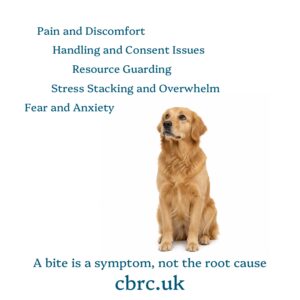
Why a dog might bite: the most common underlying causes.
Fear and anxiety.
Fear biting is extremely common. The dog is not trying to win they are trying to make the scary thing go away.
Pain and discomfort
Pain changes behaviour. Dogs in pain often have reduced tolerance and may bite during handling.
Common pain sources include:
- ear infections
- dental pain
- arthritis / joint pain
- stomach discomfort
- skin pain (hot spots, allergies)
If biting appears out of character, a veterinary check is essential.
Handling and consent issues
Many bites happen during:
- collar grabs
- putting on a harness
- wiping paws
- grooming
- nail trims
- lifting the dog
Often the dog has been saying no for a long time, but the humans haven’t realised it.
Resource guarding
Guarding is usually fear-based: fear of losing something important.
Dogs may guard:
- food
- chews
- toys
- stolen items
- resting places
- people
Stress stacking and overwhelm.
A dog’s bite threshold drops when stress has been building.
A dog may cope with one thing, but not five things in a row.
That’s why bites can happen after a busy day, a change in routine, visitors, noisy environments, or repeated triggers.
But he’s never bitten before, why now?
Because biting is often the end of a long story.
Sometimes the dog has been:
- repeatedly pushed past their comfort zone
- forced into greetings or handling
- punished for growling or warning
- living with chronic stress or pain
- trapped in situations they cannot escape
Eventually, the dog learns that the only thing that works is escalation.
What to do if your dog has nipped or bitten
1) Safety first
- prevent repeats (management is not failure)
- use distance, barriers, leads, muzzles where appropriate
- stop practising the scenario that caused the bite
2) Don’t punish the dog
Punishment may stop the warning signals, but it doesn’t remove the fear, pain, or panic.
It can make the next bite more likely and more severe.
3) Look for the pattern
Ask:
- What happened right before?
- Where was the dog?
- Who was involved?
- Was the dog trapped?
- Was there handling?
- Was there a resource?
- What was the dog’s body language earlier in the day?
4) Rule out pain
A veterinary check is a key step, especially if the behaviour is new or escalating.
5) Get specialist support
Biting is serious, but it is also understandable when you look at the emotional drivers.
At CBRC, we approach biting and nipping by working with the why the fear, stress, trauma, pain, and coping skills not by simply trying to suppress the behaviour.
We start with the dog’s micro-signals and thresholds, build safety and predictability, and teach alternative coping strategies so the dog no longer feels they need to use their teeth.
Final thought: a bite is a symptom, not the root cause.
A dog who bites is not a bad dog.
They are a dog who has reached the end of their ability to cope.
If we listen earlier to the whispers before the shout we can prevent bites, protect everyone’s safety, and help the dog feel safe enough that they don’t need last-resort behaviour.
The Canine Behaviour Rehabilitation Centre CBRC
CBRC specialises in complex behaviour cases and welfare‑led rehabilitation. If you’d like support — whether that is an assessment, a structured plan, or residential rehab — you can contact us here: CONTACT US