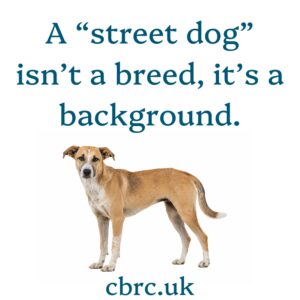
A “street dog” isn’t a breed. It’s a background.
When people say Romanian street dog, Bosnian street dog, Bulgarian, Greek, Serbian (and so on), they’re usually describing dogs who come from free-roaming populations where survival, scavenging, avoiding conflict, and reading risk matters more than being biddable or cuddly. Some settle beautifully into family life. Others really struggle and it’s not because they are “bad dogs” or because the adopter “did it wrong”. It’s because genetics, early development, and the realities of import/adoption can stack the deck.
This guide is to give a real, welfare-led insight into what “street dog” often means, so adopters and fosters can make informed choices and set the dog up properly.
First, the big myth: “Street dog = mixed breed like a Labrador cross”
In UK pet language, mixed breed often means a dog with recent ancestry from modern pedigree breeds (e.g., Collie x Lab). Many European street dogs are different.
A lot are closer to landrace / village dog-type populations dogs shaped over generations by environment and survival pressures rather than by humans selecting for a specific “job” or look.
That doesn’t make them less lovable. It just means their default settings can be different to what many UK homes expect.
Genetics: what a street dog is (and why DNA tests can look “chaotic”)
1) Landrace / village dog genetics (often the core)
Street dogs frequently come from genetically diverse, free-breeding populations. You can see:
- High genetic diversity compared with many pedigrees
- Traits that look “primitive” or self-directed: independence, environmental awareness, strong survival behaviours
- Wide variation within the same litter (because the population is broad)
2) “Breed mixes” can still be present but not always in the way people assume
You can get recent breed influence (e.g., shepherd-type, sighthound-type, terrier-type), especially in areas where owned dogs roam or where there’s uncontrolled breeding.
But many street dogs are not a neat 50/50 cross of recognisable UK breeds. They’re often a blend of regional dog types over many generations.
3) Genetics is only half the story: early development is the other half
Even a genetically steady dog can struggle if their early life included:
- limited safe human contact
- chronic stress (noise, conflict, hunger, competition)
- illness/pain untreated
- capture, kennelling, transport, and sudden environmental change
That early nervous system “wiring” matters. It can create a dog who is constantly doing risk assessment, even in a loving home.
What European street dogs are often like as pets (the honest version)
Some are absolute gems: social, affectionate, bombproof, and adaptable.
But many are not “instant family dogs” in the way people imagine from rescue marketing. A very common pattern is:
- They cope outside at first (sniffing, moving, distance) but struggle inside (confinement, household noises, handling)
- Or they look fine inside (shutdown, frozen, quiet) but unravel outside once they feel safe enough to express themselves
A street dog may be:
- more independent (not constantly seeking human approval)
- more cautious with novelty (new people, new places, new objects)
- more environmentally fluent (reads movement, space, exits, risk)
- more sensitive to pressure (tight lead, looming body language, forced handling)
None of that is “wrong”. It just needs a different approach.
Common behavioural challenges (and what they usually mean)
1) Shutdown / freezing / “quiet but not okay”
This is one of the most misunderstood presentations.
A dog who is still, silent, and compliant can be:
- overwhelmed
- dissociated/shut down
- trying very hard not to trigger conflict
What helps: low demand, predictable routine, gentle choice-based interaction, and letting the dog come to you.
2) Flight risk and escape behaviour
Street dogs often have strong self-preservation instincts and a history of surviving by leaving.
Common triggers:
- sudden noises
- unfamiliar men/children
- handling attempts
- doorways, cars, vet clinics
What helps: double-lead systems, secure harness, long-line protocols, door safety routines, and slow exposure to handling/equipment.
3) Handling sensitivity (collars, harnesses, grooming, vet care)
Many street dogs have not had safe, consent-based handling early on. Some have learned that restraint predicts scary things.
What helps: consent-based handling, cooperative care, muzzle training done kindly, and never “just getting it over with”.
4) Noise sensitivity and indoor stress
Homes are weird if you didn’t grow up in one.
Common stressors:
- TV sounds, washing machines, hoovers
- doors closing, footsteps, stairs
- being approached in tight spaces
What helps: safe zones, sound desensitisation at the dog’s pace, management of space, and reducing surprise.
5) Dog-dog conflict, resource competition, or “selective” social skills
Street dogs can be socially skilled but that doesn’t mean they want close contact with unknown dogs on leads.
You may see:
- intolerance of rude greetings
- guarding of food/space/people
- conflict around thresholds and tight areas
What helps: neutrality training, distance, structured parallel walks, and avoiding forced social situations.
6) Predation/chase behaviours
Some street dogs have strong chase patterns (cats, livestock, joggers, bikes). This isn’t “naughtiness” it’s a hardwired motor pattern.
What helps: management (long line, muzzle where needed), impulse control games, and safe outlets that don’t rehearse chasing.
7) Separation distress (or panic when confined)
A street dog may have coped by moving away from threat. Confinement can feel unsafe.
What helps: gradual alone-time training, predictable departures, enrichment that settles (sniffing/chewing), and avoiding sudden big jumps in alone time.
What helps most: the street dog approach (not the “pet dog” approach)
1) Decompression first, not obedience first
The first goal is not “sit” and “heel”, it’s:
- safety
- predictability
- low arousal
- trust
2) Neutrality is gold
We aim for “safe and boring” around:
- strangers
- dogs
- traffic
- household noises
Neutral is often a better goal than “friendly”.
3) Consent-based handling and cooperative care
Street dogs often do best when they learn that:
- they can say “no” safely
- humans will listen
- handling becomes predictable and rewarding
4) Management is not failure
Using long lines, baby gates, crates (only if the dog finds them safe), and muzzles can be the difference between success and repeated trauma.
5) Build confidence through choice and tiny wins
Progress often looks like:
- choosing to approach
- choosing to sniff
- choosing to disengage and settle
Not dramatic “breakthrough moments”.
A realistic first 30 days (for adopters and fosters)
Week 1: Safety and observation
- keep life small and quiet
- avoid visitors and busy walks
- establish toilet routine and feeding routine
- start a simple diary: triggers, thresholds, recovery time
Week 2: Gentle structure
- introduce predictable micro-routines
- short, low-pressure outings (quiet areas)
- begin consent-based handling games
Week 3: Expand the world carefully
- add one new thing at a time
- keep distance from triggers
- start neutrality training patterns
Week 4: Review and adjust
- identify what’s improving and what’s escalating
- decide what needs professional support
- keep management in place while skills build
Is a street dog right for you? (quick reality-check)
A street dog may be a great fit if you can offer:
- time (months, not days)
- a calm, predictable home
- secure boundaries and safety systems
- comfort with management tools
- realistic expectations about affection and sociability
A street dog may struggle in:
- chaotic, high-traffic homes
- homes with lots of visitors and hands-on handling
- situations where the dog must be “social” quickly
- homes without secure doors/garden protocols
Red flags to take seriously (without shame)
- repeated escape attempts or bolting
- escalating reactivity or biting when pressured
- panic with confinement or handling
- inability to settle for long periods
These are not moral failures, they are information and they deserve a proper plan.
Want support with your street dog?
If you are fostering or you have adopted a European street dog and you are seeing shutdown, fear, reactivity, handling sensitivity, bolting, or that constant on edge feeling you are not alone.
At CBRC we support complex cases in two main ways:
- One-to-One Behavioural Support (practical management plans)
- Residential Rehabilitation (for dogs who need a full decompression period, structured handling work, and a consistent rehab plan)
If you want a no obligation chat to talk it through, tell me your dogs age, where your dog is from, what you are seeing day-to-day, and what your ideal outcome looks like and we will work out the safest next steps.
CONTACT US
The Canine Behaviour Rehabilitation Centre CBRC