When you live with a nervous or anxious dog, the “simple” daily walk often isn’t simple at all. If your route is the same pavement loop every day — maybe because it’s all you’ve got near home, or because you need to get from the house to the fields — you’ll know the feeling: you’re doing your best, and then a stranger appears, a dog pops out of a driveway, or a bin lorry rumbles past… and suddenly your dog is over threshold.
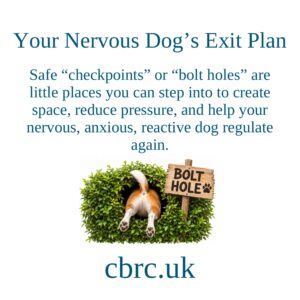
One of the most helpful things you can do (especially early on, or during a tricky patch) is to stop thinking of your walk as one long stretch of pavement, and start thinking in safe “checkpoints”. We call these bolt holes — little places you can step into to create space, reduce pressure, and help your dog regulate again.
What’s a “bolt hole”?
A bolt hole is simply a pre-chosen spot along your regular route where you can quickly and calmly move your dog out of the main flow of life.
Think:
• A quiet pull-in or lay-by
• A wide driveway entrance you can step into (without blocking anyone)
• A little lane off the main road
• A gap between hedges that gives you a few metres of distance
• The entrance to a field, a track, or even a tucked-away verge
It’s not about hiding forever. It’s about giving your dog an exit plan so they don’t feel trapped on the pavement with nowhere to go.
Why bolt holes matter for anxious dogs
Many anxious dogs struggle most when they feel they can’t increase distance. Pavements can be narrow, busy, and full of “surprises” — and if your dog can’t cope with a dog or stranger even on the other side of the road, that trapped feeling can tip them into barking, lunging, freezing, or trying to flee.
Bolt holes help because they:
• Increase distance fast (distance is your best friend)
• Reduce the “head-on” pressure of an oncoming trigger
• Give you a predictable plan (predictability reduces stress)
• Let you reset before your dog spirals
Over time, your dog learns: “We have options. My human will help me.” That changes the whole emotional tone of the walk.
Step one: map your route like a safety plan
On your next few walks, don’t worry about training. Just observe and identify 5–10 bolt holes on your usual route.
Ask yourself:
• Where can I step off the pavement safely?
• Where do I get the best visibility (so I can spot triggers early)?
• Where can I create distance without feeling rushed?
• Where can I pause without blocking people?
If you can, pick bolt holes that give you choices: one for “trigger ahead”, one for “trigger behind”, one for “sudden surprise”.
Step two: practise using bolt holes when nothing is happening
Bolt holes work best when they’re familiar, not only used in emergencies.
A few times per walk, when the world is calm:
• Calmly say your cue (something like “this way”)
• Step into your bolt hole
• Breathe, soften your body, loosen the lead
• Do 20–60 seconds of easy decompression (more on that below)
• Then continue your walk
You’re teaching your dog: “This is a safe place. This is normal.”
Handler focus: the “anchor” that helps your dog stay with you
Handler focus isn’t about forcing eye contact or making your dog “behave”. For anxious dogs, it’s about giving them a simple, rehearsed way to connect back to you when they’re wobbling.
In bolt holes, handler focus can look like:
• Turning your body slightly sideways (less pressure)
• A gentle cue like “with me”
• Rewarding tiny moments: a head turn towards you, a softening in the body, a breath out
You’re not trying to “out-train” fear. You’re helping your dog feel supported and guided.
If your dog is already panicking, focus work may be too hard in that moment. That’s when we go even simpler — distance first, then decompression.
Scatter feeding in bolt holes: why it helps (and when it doesn’t)
Scatter feeding (sprinkling food on the ground for your dog to sniff out) can be brilliant in bolt holes because sniffing:
• Lowers arousal
• Slows the body down
• Gives the dog something safe and species-appropriate to do
• Can interrupt the “scan and spiral” pattern
But it must be used correctly.
Use scatter feeding when:
• You’ve already created enough distance
• Your dog can still eat (eating is a useful “can cope” sign)
• The ground is safe (no broken glass, no high-value rubbish)
Avoid scatter feeding when:
• It would keep your dog too close to the trigger
• Your dog is so stressed they can’t eat (then it’s not helping)
• You need to move away quickly for safety
A simple rule: food supports the plan — it doesn’t replace the plan. The plan is distance.
A real-life example: the “pavement pinch point”
Most regular routes have a pinch point — a narrow bit where you can’t easily pass someone.
This is where bolt holes shine. If you know that pinch point is coming:
• You can pre-emptively step into a bolt hole before you meet anyone
• You can let the trigger pass at a safer distance
• Your dog doesn’t have to “hold it together” in a tight space
That one change often reduces the number of blow-ups dramatically.
What success looks like
Success isn’t “my dog never reacts again”. Success is:
• Your dog recovers faster
• Your dog trusts you to create space
• Your dog spends more of the walk under threshold
• You feel less dread about leaving the house
And that’s the foundation you build real behaviour change on.
Quick safety note (because it matters)
If your dog is fearful or reactive, prioritise space and safety. Don’t try to “train through” a trigger at close range, and don’t use food to lure your dog closer to something they’re scared of. If you’re unsure, get tailored support — especially if there’s any bite history or your dog is at risk of bolting.
The Canine Behaviour Rehabilitation Centre – CBRC specialises in complex behaviour cases and welfare‑led rehabilitation. If you’d like support — whether that is an assessment, a structured plan, or residential rehab — you can contact us here: CONTACT US