

Sometimes we don’t realise we’re doing it
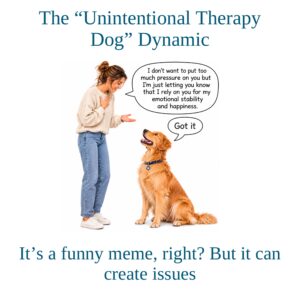
We love our dogs so much, they feel like the safest place in the world. They are the one constant. The one thing that makes us smile when everything else feels heavy.
Many of us have been lucky enough to have a dog that deeply touched us…a soul/heart dog and we understand just how strong that bond can be. But, for some people, a dog becomes their main source of comfort, stress relief, and emotional regulation.
The problem is: your dog didn’t sign up to be your therapist.
And for anxious, sensitive, or already-nervous dogs, that invisible “job role” can quietly add a lot of pressure.
We see a lot of dogs with behavioural issues, and we deal with big behavioural problems. We also work with both ends of the lead because rehabilitation works when it is holistic and for that to happen, we work with the owners/families too. So, this blog is based on knowledge and experience and isn’t about judgement, it’s about awareness — and then guiding you with information to help you make small changes that help your dog feel safer, lighter, and more able to rely on you.
The “Unintentional Therapy Dog” Dynamic
For many reasons lot of dogs end up in a role where they are unknowingly used as:
- The main comfort when their human is upset
- The only reason their human gets through the day
- The emotional anchor in the house
- The thing their human clings to when stressed, lonely, overwhelmed, or anxious
Sometimes it looks like constant cuddling and holding. Sometimes it looks like never letting the dog have space. Sometimes it’s checking on them all the time. Sometimes it’s telling them “it’s okay” over and over, or needing them close every second.
And sometimes it’s simply the emotional weight in the relationship — the dog becomes responsible for the human feeling okay.
Most owners don’t mean to do this. It comes from love.
But dogs feel it.
Why This Can Be Hard on Dogs (Especially Nervous Ones)
Dogs are brilliant at reading us. They notice breathing changes, tension, tears, tone shifts, pacing, agitation — all of it. They don’t need words to know something is “off”.
If a dog is already anxious or sensitive, and they’re living with a human who is relying heavily on them for emotional stability, the dog may start to feel like:
- They must stay “on duty”
- They can’t fully relax
- They have to monitor the human constantly
- It’s their job to fix things
- They must stay close “just in case”
That can show up as:
- Clinginess and inability to settle alone
- Increased hypervigilance (watching you constantly)
- Separation distress (because you’re not okay without them)
- Reactivity (because their nervous system is already overloaded)
- Shutdown, avoidance, or irritability
- A dog who looks “fine” but never truly decompresses
An anxious dog doesn’t need more emotional responsibility — they need less.
They need the human to be the steady one. The safe one. The predictable one.
The Role Swap: Your Dog Needs to Rely on You
In a healthy relationship, the dog should be able to rely on the human, not the other way around.
That doesn’t mean you can’t love your dog deeply. It doesn’t mean you can’t cuddle them. It doesn’t mean you can’t feel comfort from them.
It means your dog shouldn’t feel like they are carrying you.
A good question to ask yourself is:
- “If my dog had a bad day emotionally, would they feel safe leaning on me?”
- “Or would they feel they have to keep it together because I can’t?”
The goal is: you become the dog’s regulation.
Not your dog becoming yours.
How to Take the Pressure Off (Practical, Dog-Centred Changes)
Small changes can make a BIG difference.
1) Give your dog permission to be a dog (not an emotional support tool)
Instead of always asking your dog to come in close, start offering space as a normal, safe thing.
- Let them choose where they rest
- Don’t constantly call them back to you
- Don’t make every moment about connection
- Notice if your dog is “performing calm” while actually tense
A dog who can choose distance is a dog who feels safer.
2) Do what your dog wants to do (not what you need)
If you’re stressed, it’s easy to want the dog close, still, cuddly, and soothing.
But many dogs regulate best through movement, sniffing, exploring, and choice.
Try swapping “I need a cuddle” for:
- A quiet field walk where your dog can sniff properly
- A long-line wander with no pressure to interact
- A decompression walk (not a training session)
- Letting them potter and investigate at their pace
If your dog is nervous, avoid busy dog parks where they’ll be forced into social situations. Instead, think: space, freedom, and sniffing.
3) Add scent work (because sniffing is therapy for dogs)
Scenting isn’t just enrichment — it’s nervous system support.
Simple ideas:
- Scatter feeding in grass
- “Find it” games with treats around the house/garden
- Snuffle mats
- Cardboard box searches
- Hiding a toy or treat trail for them to track
Sniffing lowers arousal and helps dogs process the world more safely.
4) Stop asking your dog to “fix” your feelings
If you notice yourself doing things like:
- Holding your dog tightly when you’re upset
- Crying into their coat
- Repeatedly telling them “it’s okay” while you’re panicking
- Needing them to stay close so you can cope
Pause and ask: “What do I need right now that isn’t my dog’s job?”
That might be:
- A friend
- A support group
- A routine
- Professional support
- Better sleep
- Boundaries with people
- Practical help
Your dog can be part of your life — but they shouldn’t be your only lifeline.
5) Become the calm, predictable base
Dogs feel safe when humans are consistent.
That looks like:
- Calm voice, calm body
- Clear routines
- Fewer emotional “swings” directed at the dog
- Not over-checking, over-reassuring, or over-managing
- Giving the dog a job that suits them (sniffing, chewing, resting), not you (comforting)
If your dog is anxious, your steadiness is everything.
A Final Thought (No Shame, Just Support)
If you recognise yourself in this, please don’t beat yourself up.
Most people who lean on their dog are doing it because life has been hard — and their dog feels like the only safe thing.
But the kindest thing you can do for your dog is to take that weight off their shoulders.
Let them be a dog.
Let them sniff.
Let them choose.
Let them rest.
And let the relationship shift into what it’s meant to be:
You are their safety. Not the other way around.
If You Need Help
CBRC specialises in complex behaviour cases and welfare‑led rehabilitation. If you’d like support — whether that is an assessment, a structured plan, or residential rehab — you can contact us here: CONTACT US
