
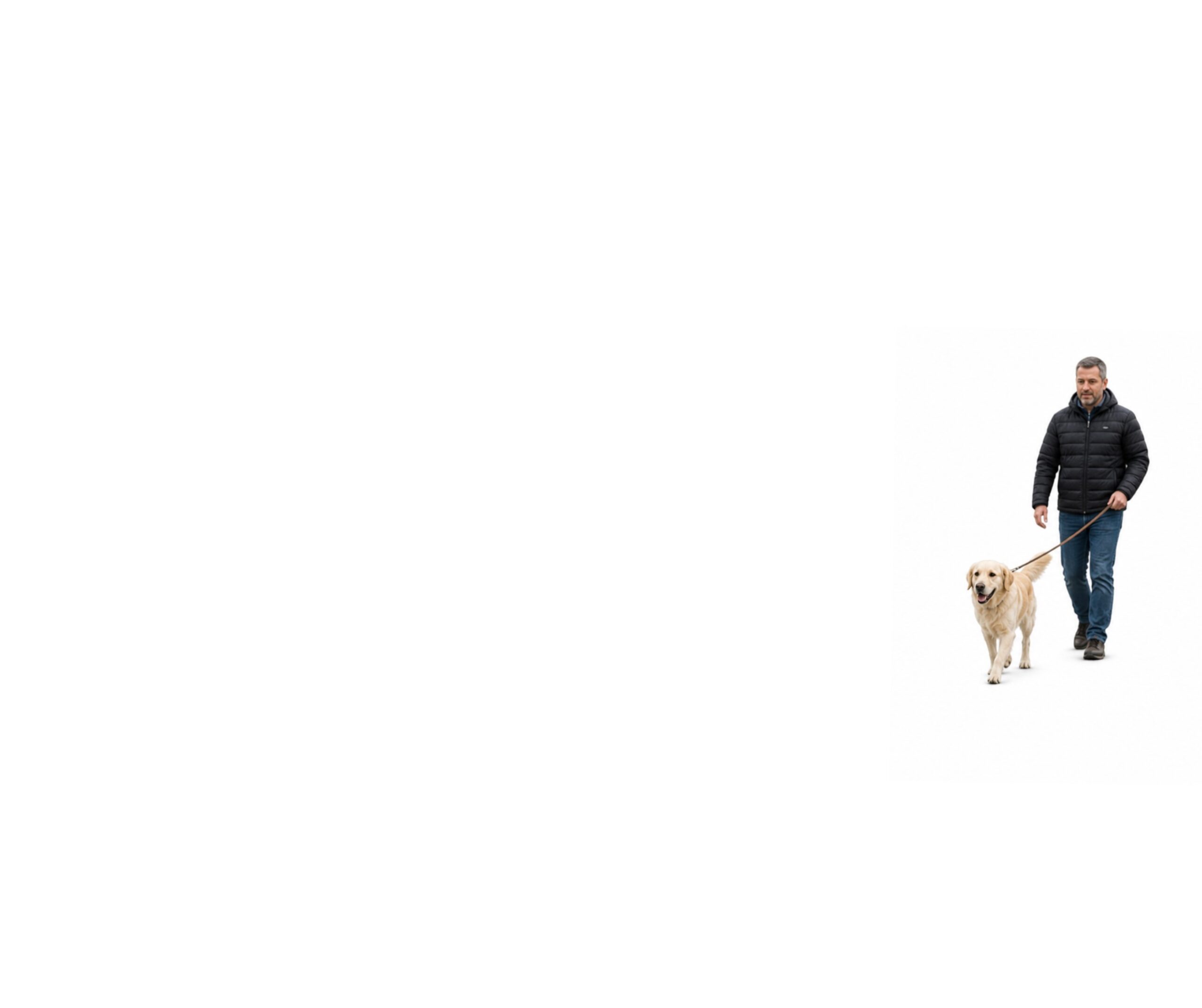
Walking an Anxious Dog When Off‑Lead Dogs Approach: A Practical How‑To Guide
The goal (realistic, not perfect)
This guide isn’t about turning your anxious dog into a social butterfly. It’s about helping you get from A to B safely, reduce scary moments, and build your dog’s confidence over time.
Your priorities are: 1. Safety (prevent contact if your dog can’t cope) 2. Distance (space is your best training tool) 3. Calm exits (leave before things explode) 4. Repetition of good outcomes (your dog learns from what keeps happening)
A rehab-diary truth: most “reactivity” is a dog asking for space
A lot of anxious dogs aren’t being “naughty” on walks. They’re doing their best with a nervous system that’s already on alert.
When an off-lead dog appears and comes in fast, your dog’s options feel limited: freeze, flee, or fight. Barking and lunging is often the dog shouting: “Please don’t come closer.”
So our job is to become the buffer.
Before you even leave the house (set yourself up to win)
Choose the right time and place
- quieter routes, wider paths, open sight lines
- avoid peak dog-walking times if you can
- consider short “sniff walks” rather than long endurance walks
Use the right equipment (comfort + control)
- well-fitted Y-front harness (no restriction across shoulders)
- long line for decompression (not retractable)
- treat pouch with high-value food
- optional: yellow “NEEDS SPACE” lead sleeve
- if needed: muzzle (properly introduced, not as a last-minute panic tool)
Have a plan before the trigger happens
If you wait until the off-lead dog is already 3 metres away, you’re in firefighting mode. Decide now: – Where will you step off the path? – What’s your “U-turn” cue? – What phrase will you use to advocate to other owners?
Your three most useful skills on walks
1) The emergency U-turn (your exit strategy)
Teach at home first.
How: – say your cue (“This way!” / “Turn!”) – turn smoothly and move away – feed as you go (rapid little treats)
This isn’t bribery. It’s a pattern that tells your dog: we leave safely when things feel hard.
2) The “find it” scatter (sniffing = regulation)
When you need to buy 3–10 seconds: – toss a handful of treats into grass – let your dog sniff – keep your body between your dog and the approaching dog
3) The body block (be the buffer)
Step forward, shoulders square, calm posture. – your dog stays behind you – you create a physical barrier – you control the space
What to do when an off-lead dog appears (step-by-step)
Step 1: Spot early, act early
The earlier you move, the less drama.
If you see an off-lead dog: – calmly increase distance immediately – step off the path, behind a car/hedge/tree if possible – shorten your lead for safety (not tight and choking, just controlled)
Step 2: Decide: exit, park, or pass
- Exit: U-turn and leave (best option for many anxious dogs)
- Park: step off path, scatter food, body block, let the other dog pass
- Pass: only if there is enough space and your dog is coping
Step 3: Advocate clearly to the other owner
Keep it short and boring. Examples: – “Can you call your dog please — mine isn’t friendly.” – “Please give us space — he’s in training.” – “Could you pop your dog on lead for a moment?”
You don’t owe anyone your life story.
Step 4: If the dog keeps approaching
Use layers: – body block + firm voice: “STOP. GO HOME.” – throw treats towards the approaching dog (a “treat bomb”) to slow them down – move away at an angle (don’t stand still hoping it resolves)
If your dog is panicking, your job is not training — it’s getting out.
What not to do (common mistakes that make it worse)
- Holding the lead tight and static: often increases frustration and panic
- Forcing greetings: “He has to learn” can create setbacks
- Picking small dogs up in a rush: can trigger jumping and grabbing from the other dog (do it only if you must, and turn your body away)
- Telling your dog off for barking: it doesn’t reduce fear; it often adds pressure
Thresholds: how to tell if you’re too close
Green (learning can happen): – can eat – can sniff – can look at the dog and look away
Amber (move away): – stiff body, closed mouth – hard staring – whining, pacing, pulling
Red (leave now): – barking/lunging – spinning, frantic behaviour – freezing/shut down
Distance is not avoidance. Distance is training space.
If your dog does react (how to recover without spiralling)
In the moment
- create distance (U-turn, step behind a barrier)
- feed once your dog can take food again
- keep your voice calm and neutral
After the incident
Think “decompression”, not “make up for it”. – shorter walk – sniffy route home – quiet time afterwards
A stressed nervous system needs recovery time.
Building long-term progress (the training bit)
Practise at safe distances
Set up controlled sessions where you can see dogs far away. – reward calm observation – reward disengagement (looking away) – leave while your dog is still coping
Teach a default behaviour
Examples: – “Behind” (dog moves behind your legs) – “Middle” (dog stands between your legs) – “Let’s go” (move away together)
Choose your battles
If your dog has had three hard days, don’t do the busy park walk. Progress isn’t linear.
Special notes for dogs with a bite risk
If there is any chance your dog could bite another dog or a person in a close encounter: – get professional support – consider muzzle training (properly conditioned) – avoid narrow paths and tight gateways – prioritise management over “social exposure”
Want support with anxious or reactive walks?
If walks have become stressful — you’re scanning constantly, dreading off-lead dogs, or feeling like you can’t keep everyone safe — you’re not alone.
At CBRC, we can help you build a clear, welfare-led walking plan that fits your real life. That might be 1:1 behavioural support to build skills and confidence, or a residential rehabilitation stay for dogs who are struggling to cope day-to-day.
