
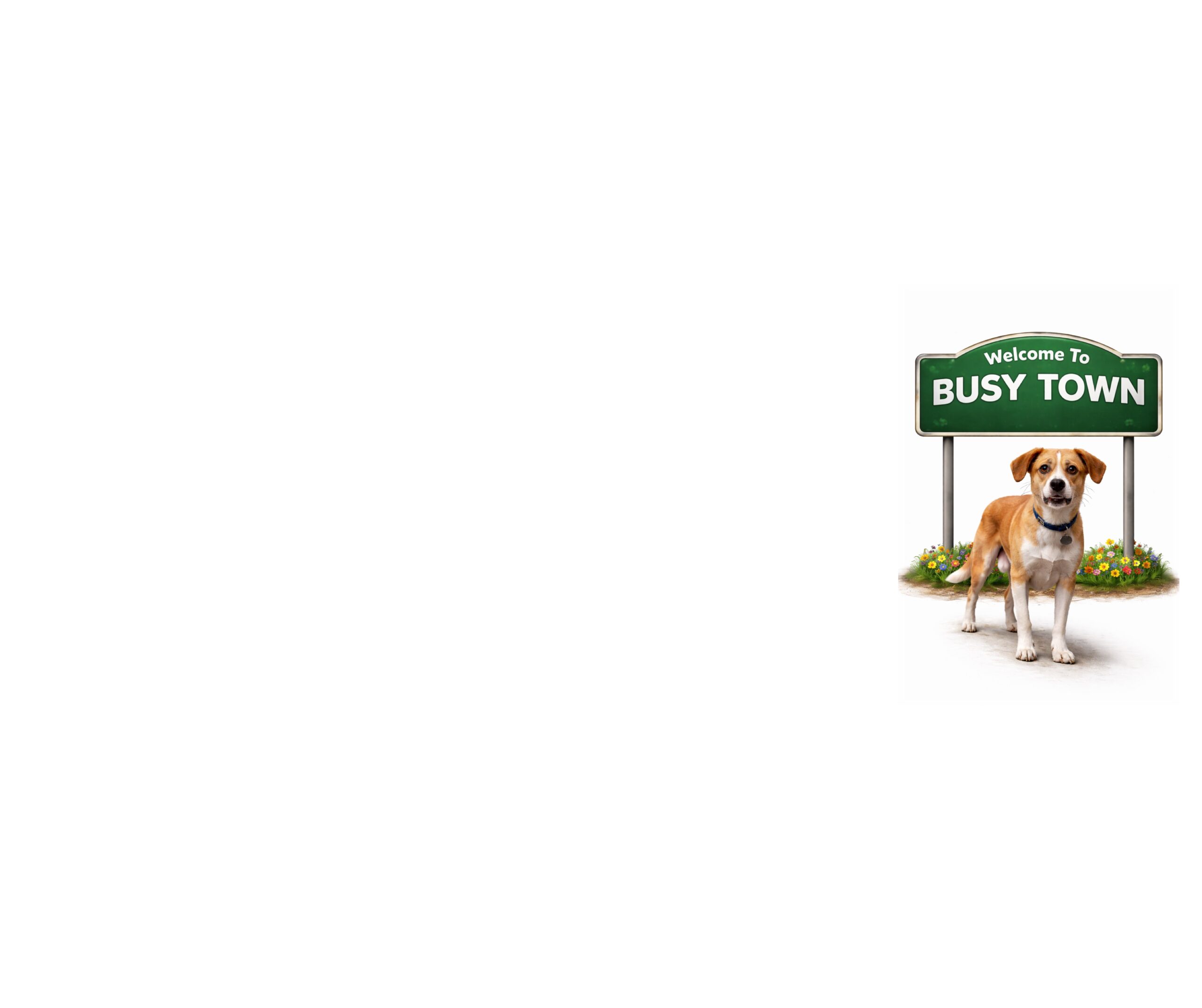
The Townie Dog: Helping Anxious Dogs Cope in Busy Places
Not every dog lives a quiet rural life with empty lanes and fields for miles.
Many dogs are townie dogs living in a town, a busy village, a housing estate, or a built-up area where the world is close, loud, and unpredictable.
And if you’ve got an anxious dog in that environment, it can feel relentless.
You can love your dog to bits and still dread the next walk. You can be doing your best and still feel judged when your dog barks, freezes, spins, or tries to flee. You can be trying to get them out more and yet every outing seems to make things worse.
This blog is for the owners living that reality and for anyone who needs permission to stop forcing normal when normal is too much.
Why towns can be so hard for anxious dogs
Towns and busy villages are full of things that push an anxious dogs nervous system up:
- Close passing distances (narrow pavements, alleyways, doorways)
- Sudden appearances (people stepping out of shops, dogs coming round corners)
- Constant noise (traffic, scooters, bins, deliveries)
- Unpredictable movement (kids, prams, bikes, runners)
- Off-lead dogs in small green spaces
- Lots of scent and social information (which can be overwhelming)
- Nowhere to just breathe
For a dog who is already scanning for threat, the environment doesnt give them enough space to regulate.
And when a dog can’t regulate, their threshold drops. That means they react faster and recover slower.
Common struggles owners face (and why its not your fault)
1) We cant even get out the front door
Doorways and front gardens can become a pressure point. The dog learns that leaving the house predicts stress.
2) People dont give us space
In towns, you often cant create distance even when youre trying. People walk straight up, dogs appear suddenly, and you end up managing constant near-misses.
3) My dog is fine in the house but falls apart outside
Thats common. Indoors is predictable. Outdoors is not.
4) I’m exhausted and I feel guilty
Owners of anxious townie dogs often carry two heavy things at once: constant management and constant guilt.
You are not failing. You are living in a hard environment with a dog who finds it hard.
The goal isn’t more exposure. It’s better exposure.
A lot of well-meaning advice says: Just take them out more and they will get used to it.
For anxious dogs, that can backfire.
If a dog is repeatedly pushed over threshold, they dont get used to it they practise panic.
Progress usually comes from:
- keeping the dog under threshold
- building predictable patterns
- giving the nervous system time to come down
- choosing environments that the dog can cope with
Practical techniques for coping (real-world, town-friendly)
1) Change the timing, not just the training
If you can, walk at quieter times:
- early morning
- late evening
- during school hours
This isn’t avoidance. It’s smart management while you build skills.
2) Shorter, calmer outings beat long stressful walks
For many anxious dogs, a 10-minute calm outing is more valuable than a 60-minute ordeal.
Think: quality over quantity.
3) Use pattern games and predictable routines
Anxious dogs cope better when they know what happens next.
Simple patterns can help:
- 1-2-3 treat rhythm while passing triggers
- find it scatter feeding on the ground
- lets go U-turns practised when nothing is happening
The point is not bribery. The point is regulation and predictability.
4) Give yourself permission to create distance
Distance is not failure. Distance is a training tool.
Practical ways to create it in town:
- cross the road early
- step into a driveway or doorway (briefly, politely)
- use parked cars/hedges as visual barriers
- turn down a side street before the dog tips over
5) Reduce pressure around greetings
Many anxious dogs don’t want to greet.
You can advocate with:
- a yellow needs space lead/patch
- calm body blocking (you between dog and trigger)
- a simple script: Sorry, were training / He needs space
6) Decompression days are part of the plan
If your dog has had a hard day, the answer is not always more walk.
Sometimes the best thing you can do is a quiet day with:
- predictable routine
- sniffing in low-pressure areas
- chewing/licking activities
- rest
That’s not doing nothing. That’s nervous system recovery.
Alternatives to street walks for exercise and enrichment
This is a big one: exercise doesn’t have to mean busy pavements.
1) Sniffing is exercise
Sniffing is real work for the brain and body. It lowers arousal for many dogs and builds confidence.
Try:
- scatter feeding in a quiet patch of grass
- find it games at home
- sniffy meanders instead of marching miles
2) Enrichment at home (especially on hard days)
Home-based enrichment can take the pressure off:
- food puzzles
- lick mats
- stuffed Kongs
- chewing (appropriate, safe chews)
- cardboard shredding (supervised)
- scentwork games (hide treats, simple searches)
A dog who is mentally satisfied often copes better outside.
3) Secure field hire / private spaces
If you can access a secure field, it can be a game-changer.
It gives the dog:
- movement without social pressure
- freedom to sniff and explore
- a chance to decompress
4) Car trips to quieter locations (when possible)
If your dog can cope with the car, a short drive to a quieter spot can be more beneficial than battling the local high street.
5) Training for life skills, not just obedience
For anxious townie dogs, the most valuable training is often:
- calm lead skills
- disengagement (looking away from triggers)
- settling on a mat
- consent-based handling
- muzzle training (as a positive safety tool)
These are coping skills.
What success looks like
Success isn’t always my dog loves the town now.
Sometimes success is:
- fewer explosions
- faster recovery
- a dog who can pass at a greater distance
- a dog who can take food outside again
- a dog who can rest properly after a walk
- an owner who feels confident advocating
Progress is often quiet.
Final thought
If you’ve got an anxious dog in a town or busy village, you are not alone and you are not doing it wrong.
The answer is rarely ‘to push through’.
The answer is usually a mix of decompression, smart management, predictable patterns, and choosing environments your dog can actually cope with so they can learn.
If you would like help to build a town-friendly plan that fits your dog and your real life, reach out. The goal is always the same: safety, welfare, and a dog who feels more secure in the world they live in.
