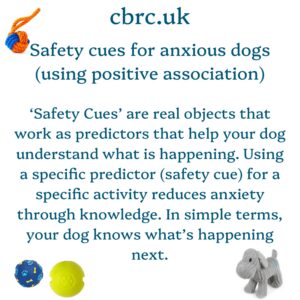
Safety cues: a simple tool that helps anxious dogs feel safer.
If you live with an anxious or very nervous dog, you will know how quickly “small” things can feel huge to them — leaving the house, walking to the car, getting in the car, arriving somewhere new.
One of the kindest, most practical tools you can use is something we call a safety cue.
A safety cue is a consistent signal that tells your dog:
“You are safe. I’ve got you. This is one of your safe situations.”
It can be an object (like a toy), a word/phrase, or a tiny routine you repeat the same way every time.
This is not about forcing a dog through fear. It is about building positive association and predictability, so their nervous system has something reliable to lean on.
What is a “positive association”?
A positive association simply means your dog learns:
“When this happens, good things follow.”
Over time, the cue itself can become calming because it predicts safety, space, and good outcomes.
The golden rule: one safety cue = one safe context
Pick one special item (or phrase) and use it only for the specific situation you want to improve.
Example: the “secure field toy”
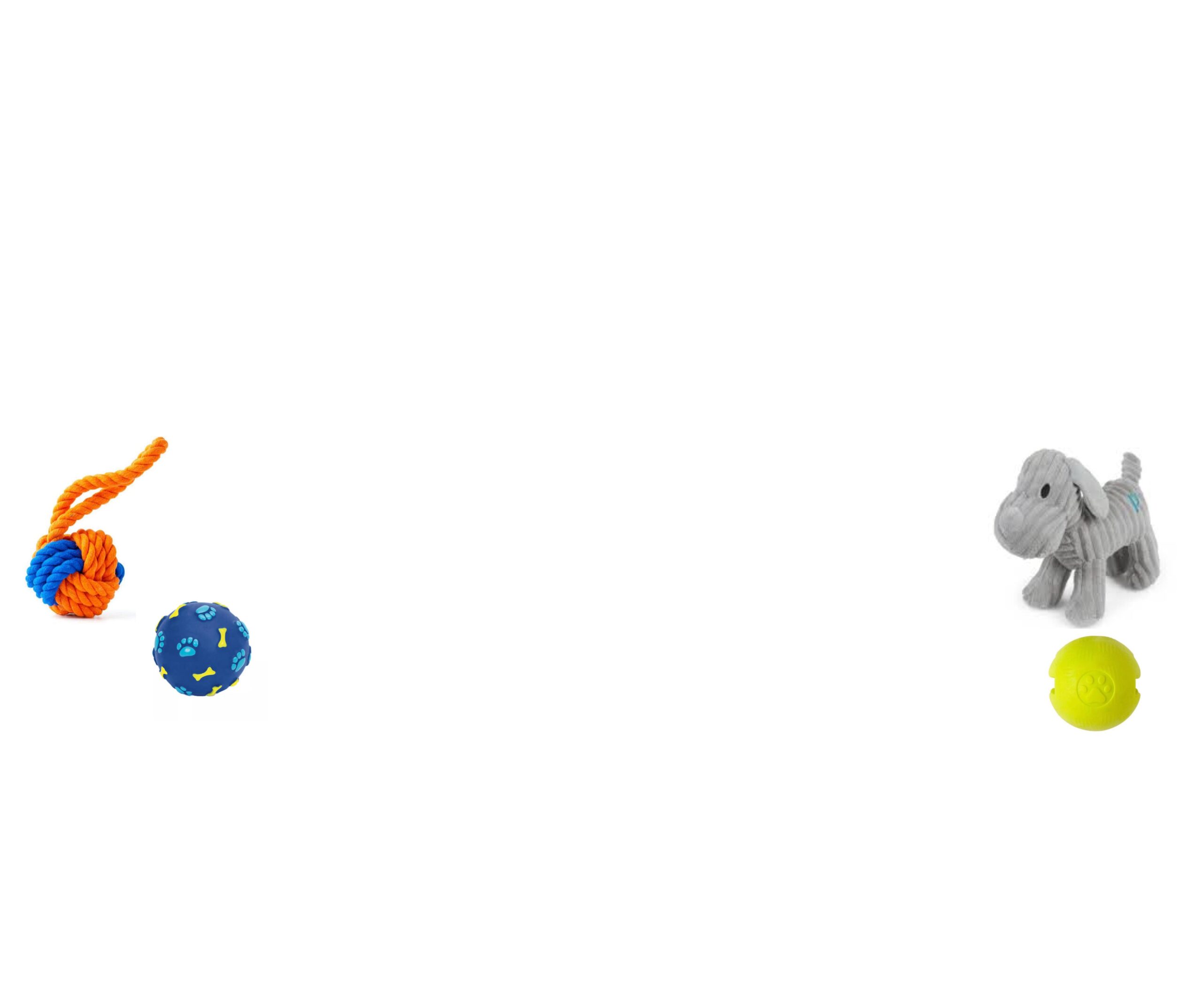
Choose a toy your dog genuinely loves (tug, ball, squeaky, whatever is safe and appropriate for your dog).
That toy becomes the secure field toy, and it only appears when: – you are heading to the secure field, and/or – you are inside the secure field and the gate is shut.
You do not bring it out randomly at home, on walks, or in stressful places.
Why? Because you want the toy to become a predictor:
Toy appears → we are going to the safe place → nothing scary is expected of me → I can relax.
A simple “house to car to secure field” routine (step-by-step)
1) Keep everything boring (calm is the goal)
No hype, no rushing, no “come on come on come on.” Anxious dogs don’t need excitement — they need clarity.
2) Start the safety cue before the hard bit
If the hardest part is leaving the house or approaching the car, introduce the cue just before that moment.
For example: – show the secure field toy briefly (don’t wave it around) – say your chosen phrase in a calm voice (e.g., “Safe trip” / “Field time”)
3) Move in tiny, winnable steps
For a very nervous dog, your “win” might be: – stepping into the hallway – stepping out the front door – walking to the car and pausing – sniffing near the car – putting front paws in – hopping in fully.
If your dog hesitates, that’s information — not stubbornness. Pause, breathe, give space, and keep it gentle.
4) The big payoff happens at the safe place
Once you arrive at the secure field and the gate is shut: – the special toy comes fully “alive” – play starts (or scatter feeding/sniff time, depending on what your dog finds soothing)
This is how the association becomes strong and meaningful.
5) The cue disappears when the safe context ends
When you are leaving the field, the toy goes away again (calmly, no drama). That keeps the cue “special” and reliable.
What safety cues can be?
For pet owners, the easiest ones are usually: – A specific toy (only for the secure field / safe outing) – A specific lead/harness (only used for “safe trips”) – A blanket/mat (car-only “safe blanket”) – A phrase (short, calm, always the same) – A mini routine (same order: lead on → pause → car → settle)
You can use more than one but start with one so it stays clear.
Common mistakes (and how to avoid them)
1) Using the cue when you cannot keep the dog safe
If you bring out the “safe toy” and then the dog ends up overwhelmed, rushed, or forced into a scary situation, the cue can lose trust.
A safety cue only works if it reliably predicts a safe outcome.
2) Bringing the special item out all the time
If the “secure field toy” is available every day at home, it stops meaning “secure field.” Keep it specific.
3) Trying to use the cue to push through fear
The cue is not a remote control.
If your dog is already panicking, barking, freezing, or trying to flee, the priority is: – distance – time – safety – reducing pressure.
Then you build the association again at a level your dog can cope with.
A gentle safety note
If your dog is extremely fearful, has a bite history, or you are struggling to handle them safely around doors/cars/lead equipment, please don’t just “try a toy and hope.”
You may need: – a handling plan – a safer setup (double lead, harness choice, car loading plan) – a step-by-step behaviour program.
That is not failure — that’s good risk management and good welfare.
If you want to try this today (quick start)
- Pick one special toy or item.
- Name it (in your head): “secure field toy.”
- Use it only for the secure field routine.
- Keep the process calm and predictable.
- Make the secure field the big positive payoff.
Be consistent because consistency is what makes it work.
The Canine Behaviour Rehabilitation Centre CBRC
CBRC specialises in complex behaviour cases and welfare‑led rehabilitation. If you’d like support — whether that is an assessment, a structured plan, or residential rehab — you can contact us here: CONTACT US