Large guardian breeds are not big pet dogs. They are a completely different type of dog genetically, emotionally, and behaviourally.
When people say Caucasian Shepherd (Ovcharka), Carpathian Shepherd, Central Asian Shepherd, Kangal/Anatolian, Šarplaninac, Tornjak, Maremma, Pyrenean Mountain Dog, and similar, they are usually talking about dogs developed to live with livestock and make independent decisions about threats.
That does not mean they cannot live in UK homes. Some do brilliantly. But if you adopt or buy one expecting a Labrador-style family dog, you can end up with a dog who is overwhelmed, controlling, and genuinely dangerous not because they are vicious, but because they are doing the job they were built to do.
This guide is here to give adopters, fosters, and the general public a realistic insight into what these dogs are genetically, what they are often like as pets, the common behaviour challenges we see, and what helps.
Genetics: what a guardian breed is built for
Guardian breeds were selected for protection, suspicion, and independence not for biddability, sociability, or easy handling.
Common genetic tendencies include:
- independent decision-making (they do not wait for permission)
- territorial behaviour (home, land, vehicle, even a room)
- suspicion of strangers as a default setting
- low tolerance for pressure or conflict (they may escalate if pushed)
- high persistence (once they decide, they commit)
- strong boundary control (blocking, patrolling, positioning)
Shepherd in the name can be misleading
Many of these are not herding dogs like Collies. They are livestock guardians. Their purpose is to prevent predation and intrusion often by:
- watching
- posturing
- driving threats away
- escalating if needed
Maturity matters: these dogs often switch on later
A common trap is that the puppy seems soft and friendly, then at 1224 months the dog becomes:
- more territorial
- more suspicious
- less tolerant of strangers/dogs
That is not a training failure. It is often normal development for the type.
What large guardian breeds are often like as pets (the honest version)
In a stable, well-managed home, many guardians are:
- deeply bonded to their people
- calm and steady in familiar routines
- less busy than gundogs/herding breeds
- naturally good at watching and settling until something feels wrong
But they can also be:
- controlling about space and access
- reactive to visitors, delivery drivers, tradespeople
- highly selective with other dogs
- difficult to handle at the vet/groomer if not trained cooperatively.
- unforgiving of repeated pressure (they may not give endless warnings)
These dogs often do not want to be social. They want to be safe.
Common behaviour challenges (and what they usually mean)
1) Territorial guarding (home, garden, car, windows, gates)
This can look like:
- barking and charging fences
- blocking doorways
- patrolling boundaries
- escalating when visitors enter
Often it’s the dog doing their job: controlling access.
What helps: management (gates, secure zones), visitor protocols, and training alternative behaviours before the dog is triggered.
2) Stranger danger and handling conflict
Many guardians dislike being touched by unfamiliar people. Some will tolerate it until they don’t and then it becomes serious.
What helps: consent-based handling, cooperative care, muzzle training, and reducing forced interactions.
3) Dog-dog conflict and intolerance
Guardian breeds can be selective or intolerant, especially with same-sex dogs or rude greetings.
What helps: neutrality, space, structured parallel walks, and avoiding off-lead chaos.
4) Reactivity on lead (especially near the home)
Lead restriction + territorial instincts can create explosive behaviour.
What helps: distance, pattern games, predictable routes, and reducing rehearsals near boundaries.
5) Resource guarding (food, beds, people, access to spaces)
Guardians often guard resources that matter: space, people, entry points.
What helps: management, clear routines, trading protocols, and reducing conflict.
6) Adolescence and maturity: the my dog changed phase
This is one of the biggest heartbreak points. Owners say:
- He was fine as a pup.
- She loved everyone.
Then maturity hits and the dog becomes suspicious and territorial.
What helps: accepting neutrality as the goal, strengthening management, and getting ahead of visitor/dog exposure plans.
What tends to work well (guardian-breed approach)
1) Management is the foundation, not a last resort
With guardian breeds, management is often what keeps everyone safe while training happens.
- secure fencing and gates
- visitor protocols
- separate zones in the home
- muzzle training as a normal skill
2) Neutrality over friendliness
The goal is not everyone can stroke my dog. The goal is:
- calm observation
- predictable routines
- safe distance
3) Low-conflict, high-clarity training
These dogs often respond badly to physical pressure and confrontation. You want:
- clear routines
- clear boundaries
- reinforcement-based skills
- minimal emotional drama
4) Cooperative care is non-negotiable
Vet care, grooming, and handling must be trained slowly and kindly. Forced restraint can create long-term fallout.
5) Give them appropriate outlets
Not endless ball throwing. Think:
- calm scent work
- controlled patrol-style walks
- settling skills
- enrichment that reduces scanning, not increases it
Is a large guardian breed right for you? (quick reality-check)
A guardian breed may be a good fit if you can offer:
- secure property and strong safety routines
- calm, predictable household
- comfort with visitors not interacting with the dog
- willingness to use management tools (gates, muzzles)
- realistic expectations about maturity and neutrality
A guardian breed may struggle in:
- busy homes with lots of visitors and children’s friends
- homes where tradespeople come and go daily
- urban/high-traffic environments with constant close contact
- owners who want a social butterfly dog
Red flags to take seriously (without shame)
- escalating guarding at gates/windows
- repeated attempts to control visitors movement
- growling/snapping when handled or moved
- increasing intolerance of other dogs with age
These are not moral failures. They are information and they deserve a proper plan.
Want support with your guardian breed?
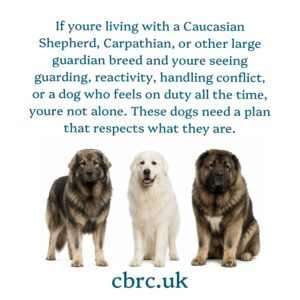
If you are living with a Caucasian Shepherd, Carpathian, or other large guardian breed and you are seeing guarding, reactivity, handling conflict, or a dog who feels on duty all the time, you are not alone. These dogs need a plan that respects what they are.
At CBRC we support complex cases in two main ways:
- One-to-One Behavioural Support (in-home or secure field sessions, plus practical management plans)
- Residential Rehabilitation (for dogs who need decompression, structured handling work, and a consistent rehab plan)
The Canine Behaviour Rehabilitation Centre CBRC
CBRC specialises in complex behaviour cases and welfare‑led rehabilitation. If you’d like support — whether that is an assessment, a structured plan, or residential rehab — you can contact us here: CONTACT US