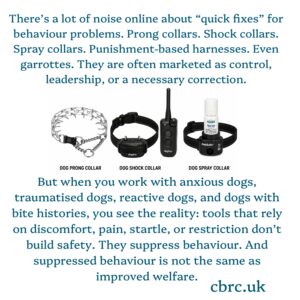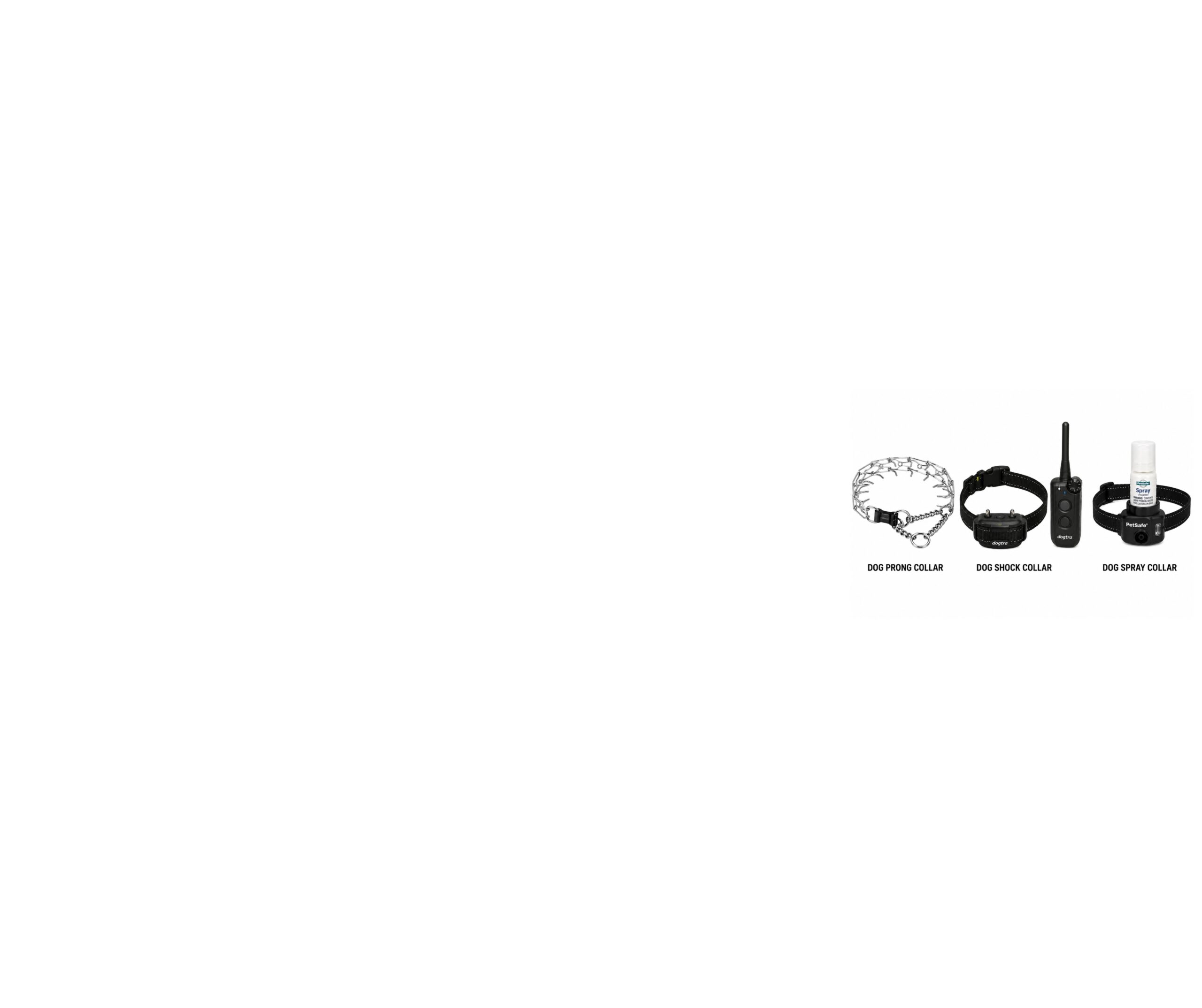
There’s a lot of noise online about “quick fixes” for behaviour problems. Prong collars. Shock collars. Spray collars. Punishment-based harnesses. Even garrottes.
They’re often marketed as control, leadership, or a necessary correction.
But when you work with anxious dogs, traumatised dogs, reactive dogs, and dogs with bite histories, you see the reality: tools that rely on discomfort, pain, startle, or restriction don’t build safety. They suppress behaviour.
And suppressed behaviour is not the same as improved welfare.
What do we mean by “aversive tools”?
An aversive tool is any tool designed to reduce behaviour by adding something unpleasant (pain, discomfort, fear, startle) or by increasing pressure until the dog gives in.
Common examples include:
- Prong/pinch collars
- Shock/e-collars (including “vibration” modes when used as a punishment/startle)
- Spray collars (citronella or similar)
- Choke chains and harsh slip use (jerking, “popping”, sustained tightening)
- Punishment-based headcollar use (rapid yanks, forcing positions)
- Punishment-based harnesses (tools used to apply pain/pressure as a correction rather than for management)
- Garrottes (a severe restraint tool that can cause significant harm)
Tools don’t exist in a vacuum. It’s not just the object — it’s how it’s used and what it teaches the dog.
Why aversive tools can be especially harmful for anxious and reactive dogs
1) They can increase fear and stress (even if the dog looks “better”)
Aversive tools can reduce outward behaviour because the dog is worried about what happens if they react.
That can look like success: less barking, less lunging, less growling.
But internally, the dog may be more stressed, more shut down, and more unsafe — because the underlying emotion hasn’t changed.
2) They can damage trust and handling tolerance
Many of the dogs we work with are already touch sensitive, conflict-avoidant, or traumatised.
If the dog learns that humans cause pain or sudden discomfort, you often see:
- increased avoidance
- increased defensive behaviour
- reduced willingness to engage
- more sensitivity around equipment
3) They can create negative associations with the environment
If a dog feels pain or a shock when they see another dog, a person, a bike, or a child, the dog may learn:
- “Other dogs make bad things happen.”
- “People approaching is dangerous.”
That can worsen reactivity over time.
4) They can remove the dog’s warning signals
Growling, freezing, lip lifting, and avoidance are communication.
When dogs are punished for warning, they may stop warning.
That doesn’t mean they’re safe. It means they’ve learned it’s not safe to communicate — and that can increase bite risk.
5) They can cause physical harm
Depending on the tool and the dog, risks can include:
- neck and tracheal injury
- increased intraocular pressure
- bruising and tissue damage
- nerve injury
- worsening pain conditions
- panic responses and thrashing
For dogs already living with stress and tension, adding physical discomfort is not neutral.
“But it works” — what people often mean
Aversive tools can produce fast changes in outward behaviour.
But fast suppression is not the same as:
- emotional safety
- resilience
- trust
- true coping skills
A dog who is quiet because they’re scared of consequences is not the same as a dog who is calm because they feel safe.
What we focus on instead (welfare-led behaviour change)
At CBRC, we prioritise approaches that reduce stress and build skills:
- decompression and predictable routines
- management that prevents rehearsal of reactions
- distance and threshold work (so dogs can stay under pressure)
- consent-based handling where possible
- enrichment that lowers arousal (sniffing, chewing, foraging)
- confidence building through safe repetition
- appropriate veterinary involvement when pain/neurology/medical drivers are suspected
We’re not interested in “winning” a moment. We’re interested in long-term outcomes.
A note on equipment: tools for management vs tools for punishment
Equipment can be used kindly or harshly.
A harness, a headcollar, a flat collar, a slip lead — any of these can be used in ways that either support the dog or increase conflict.
The key question is always:
Is this tool being used to keep everyone safe while we teach the dog? Or is it being used to make the dog stop through discomfort or fear?
Why CBRC uses slip leads (and why it’s not for training or punishment)
We’re very open about this, because context matters.
At CBRC we do use slip leads — but we do not use them as a training tool, and we do not use them as a punishment tool.
We use slip leads for safety and welfare reasons, because we work with a high number of dogs who are:
- anxiety-driven flight risks
- European dogs (often with a strong flight response and a history that makes handling more complex)
- touch reactive or easily spooked by hands reaching in
- dogs with bite histories, where reducing handling conflict is essential
A slip lead can be placed on and removed with minimal handling. That means we can connect a dog to us without having to clip a lead onto a collar or harness — which, for some dogs, is exactly the moment they panic, spin, or defend.
We also use slip leads because some dogs can reverse out of certain harnesses, or slip a collar and lead if they spook. A secure connection reduces the chance of escape, injury, or a dog bolting into danger.
So yes — we use slip leads. Not to “correct” a dog, not to intimidate a dog, and not to force compliance.
We use them to protect the dog, protect the handler, and reduce stress during transitions — especially in the early stages when trust is still being built.
Final thought
If a tool relies on pain, fear, or startle to get results, it may change behaviour — but it often does so at a cost.
Our job is not just to stop behaviour. It’s to improve welfare, build safety, and help dogs feel secure enough to make better choices.
If you’re unsure what’s right for your dog, ask for help. A good plan should make life feel safer — not scarier — for everyone involved.
The Canine Behaviour Rehabilitation Centre CBRC
CONTACT US