When we see a dog freeze, bark, lunge, hide, or refuse to move, it’s easy to focus on the behaviour we can see. But fearful and anxious behaviour is usually the output of what’s happening inside the dog: their emotional state, their body’s stress response, and their learned associations about what things mean.
A helpful way to think about this is “cognitive behaviour”: how your dog’s expectations, memories, and predictions shape what they do next.
Thoughts, associations, and predictions (in dog terms)
Dogs don’t think in sentences like we do, but they absolutely form associations.
- “That man leaning over me = scary.”
- “The lead tightening = something bad is about to happen.”
- “The car park = vet smells = I’m not safe.”
Once an association is formed, your dog’s brain starts predicting what comes next. If the prediction is “danger,” the body prepares: heart rate rises, muscles tense, scanning increases, and the dog becomes more reactive or shut down. That’s not stubbornness. It’s survival physiology.
Practical example
Your dog sees a stranger, stiffens, and barks. The barking isn’t the “problem behaviour” in isolation. It may be your dog saying, “I need space.” If barking has worked before (the person moved away), the dog learns: bark = safety returns. That learning is powerful.
Threshold: the line where learning changes
Threshold is the point where your dog can still notice a trigger and stay regulated enough to eat, sniff, respond to you, and recover.
- Under threshold: your dog can take food, disengage, and learn.
- Over threshold: your dog is in fight/flight/freeze; learning becomes harder and reactions get bigger.
A key skill for carers is spotting early signs before the explosion: closed mouth, stillness, whale eye, sudden sniffing that looks frantic, scanning, leaning away, paw lift, shaking off, refusing food, or “busy” displacement behaviours.
Trigger stacking: why “it came out of nowhere”
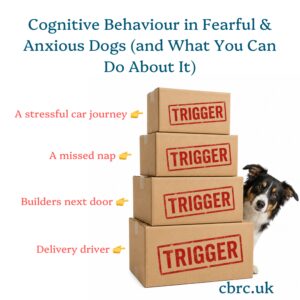
Trigger stacking is when multiple stressors pile up until the dog has no coping capacity left.
A dog might cope with one thing (a loud van), but not five things in a row (poor sleep + visitors + lead pressure + another dog staring + a sudden noise). The final trigger looks like the cause, but it’s often the last straw.
Practical example
Your dog is fine on the morning walk, then “randomly” reacts at 4pm. But the day included a delivery driver, builders next door, a missed nap, and a stressful car journey. By 4pm, the nervous system is already running hot.
What helps: build decompression into the day (sniff walks, quiet time, predictable routines) and reduce avoidable stressors while you’re working on behaviour change.
Counterconditioning: changing what the trigger means
Counterconditioning means pairing the trigger with something your dog loves, so the emotional response shifts over time.
The goal isn’t “make them tolerate it.” The goal is: trigger predicts good things, and the dog feels safer.
How to do it (simple version)
- Start far enough away so that your dog can stay under threshold.
- Trigger appears → food appears (or a favourite game, or sniff time).
- Trigger disappears → food stops.
- Repeat in short sessions.
This is not bribery. It’s emotional learning.
Example: strangers
At a distance where your dog can still eat: “Person appears” → scatter treats on the ground. If your dog can’t take food, you’re too close or the situation is too intense.
Example: lead pressure
Many anxious dogs find lead tension worrying. Practise in a calm space: gentle lead movement → treat. Teach a “follow the lead” pattern with soft handling and lots of reinforcement, so the sensation stops predicting conflict.
Consent-based handling: safety through choice
Fearful dogs often feel unsafe when they can’t control what happens to their body. Consent-based handling builds trust by giving the dog clear ways to say “yes,” “not yet,” or “no.”
What it looks like
- Offer a hand or station (mat) and wait.
- Touch briefly, then pause.
- If the dog leans in/returns, continue.
- If the dog moves away, stiffens, or stops engaging, you stop.
You can teach cooperative care skills like chin rests, paw targets, scratch boards for nails, and “start button” behaviours (the dog opts in). This reduces stress and makes progress more stable.
What progress actually looks like
With anxious dogs, progress is often: – faster recovery after a wobble – more sniffing and exploring – choosing to disengage from triggers – softer body language – being able to eat and think in places that used to be too hard
Set goals around regulation and recovery, not perfection.
When to involve a vet (and when meds can help)
Some dogs are so consistently anxious that their baseline stress level is high even at home. In those cases, training alone can be like trying to learn while your fire alarm is blaring.
Consider involving your vet (ideally alongside a qualified behaviour professional) if you notice: – persistent hypervigilance, pacing, or inability to settle – severe panic, self-injury, or escape behaviours – appetite changes linked to stress – sudden behaviour change (rule out pain/medical causes) – reactions escalating despite careful training
Medication isn’t a “last resort” or a shortcut. For some dogs, it’s a welfare tool that lowers the volume on anxiety, so learning becomes possible. Your vet may discuss longer-term anxiety support and/or situational medication for predictable stressors.
The kindest roadmap
If you take nothing else from this: fearful behaviour is information. Your dog is communicating their experience of the world.
- Reduce stress where you can.
- Work under threshold.
- Change meaning through counterconditioning.
- Build trust through consent-based handling.
- Bring in your vet when anxiety is bigger than training can comfortably hold.
Small, consistent steps add up. And for many dogs, safety isn’t something they “learn once” — it’s something we help them practise, gently, until it becomes their new normal.
The Canine Behaviour Rehabilitation Centre CBRC